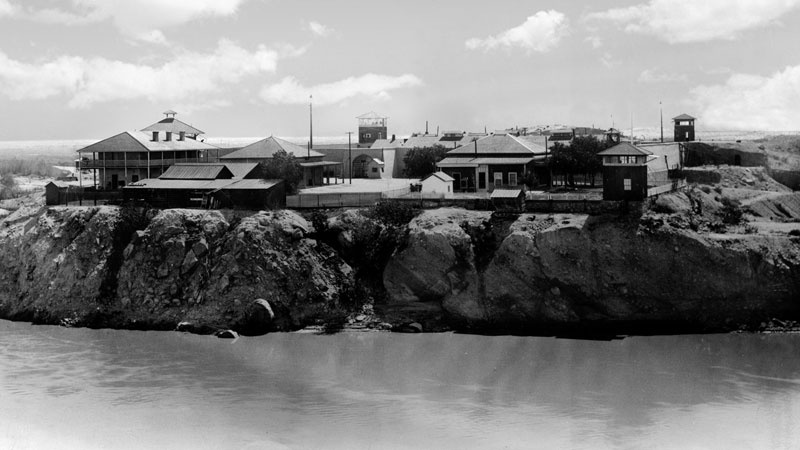
Yuma Territorial Prison History Timeline
Follow the timeline of the Yuma Territorial Prison, from its founding in 1875 through its years as a working prison and its transformation into one of Arizona’s most visited historic sites.

Pre-1875
Long before the prison stood on the bluff, Yuma Crossing was a vital gateway for explorers, missionaries, and gold seekers moving west. As the Arizona Territory grew in the late 1800s, so did the need for law and order.

1875
The Legislature authorized the Territorial Prison in 1875, and $25,000 was budgeted for the project.

1876
Ground was broken in early 1876, and some prisoners were pressed into service to build their cells. The first seven inmates moved into the facility on July 1, 1876.

1878
1878 was a lively year at the prison. The first female inmate arrived, Lizzie Gallagher. 1878 also saw the first prison escape by J. Lewis.

1882
The iconic guard tower was built. Constructed to help fight off evaporation from the water tank it covered, it gave the guards an expansive view of the area. Guards could also walk the catwalk to the top of the prison wall to walk the perimeter.

1884
After electricity was introduced at the prison, the townspeople began to refer to the prison as the country club on the Colorado. The prison had many amenities that residents in Yuma did not have; electricity, forced ventilation, sanitation with two bathtubs and three showers, and even a prison band!

1885
The iconic sally port was built. Today you can walk through the Sally port, just as the prisoner did. The first hospital in the area was also constructed; tuberculous was a dangerous killer.

1887
The Gates Riot: Several prisoners took Superintendent Gates captive, threatening him with a pistol and a knife to his neck, and demanded the prison gates be opened. Guards responded with a hail of bullets, leaving four prisoners dead and one wounded. Superintendent Gates received a knife wound to the neck, which would pain him for the rest of his life.

1891
The women's population had grown in the 13 years since Lizzie Gallagher entered the prison. The prison had no choice but to construct a new cell and small yard to house the female inmates in 1891.

1893
The prison opened the first library in the area. The prison also made the library available for the townspeople to use.

1894
With disobedience becoming an issue among the inmates, the infamous Dark Cell was constructed from the granite hilltop. The cell was windowless and left the inmate in near-total darkness. Within the cell was a cage where the inmates were placed, forced to crouch or sit because the cage was only five feet high.

1900
Along with the growth of the Arizona Territory, law and order grew, which brought more inmates to the prison. The "new yard" was completed, giving the inmates more space to socialize, exercise outside and do activities outside their cells.

1909
The prison had reached its limits and could expand no more to house the ever-growing inmate population. A new prison in Florence, Arizona, was completed in 1909, and inmates were transferred to the new prison, leaving the territorial prison empty.

1910
The growing population of Yuma needed a temporary building to use as a high school. The abandoned prison was a great quick fix, with its available buildings and cafeteria/mess hall. From 1910 to 1914, high school students in Yuma attended high school at the prison.

1915
Needing a new bridge to replace the aging pivot bridge, The Southern Pacific Railroad decided the granite bluff where the prison sat would be ideal for the new bridge. The Southern Pacific bought a large portion of the west side of the prison yard and constructed the new railroad bridge, demolishing part of the prison structures and grounds.

1941
After being picked over during the Depression, Clarisa Windsor took up a campaign to save what was left of the prison. She spearheaded the creation of the prison museum that the city of Yuma would operate from 1941 until 1960.

1961
The Yuma Territorial Prison became the third state park in Arizona.

2010-Present
The Yuma Territorial Prison faced closure until community members, Yuma Chain Gang, pulled together to raise funds to save the prison. Yuma Crossing National Heritage Area took over management of the park and has been working to keep this history alive for everyone to experience.

Learn the complete history of the Yuma Territorial Prison when you visit the park in person, and be sure to view the large granite etching as you begin your experience.
Historical Background & Stories
In the late 1800s, the Yuma Territorial Prison reflected the changing laws and social tensions of the American West. Among its inmates were several Mormon leaders imprisoned under federal anti-polygamy laws, raising questions that still echo today—were they criminals, or victims of religious persecution?
Despite its harsh reputation as a “hell hole,” the prison was also known as the “Country Club on the Colorado,” offering rare amenities like electricity, sanitation, and one of the largest libraries in the Territory.
Life inside, however, was far from easy. Extreme heat, disease, and strict discipline made daily survival a challenge. Over its 33 years, a series of superintendents—some respected, others controversial—shaped the prison’s legacy and the conditions within its walls.
Today, the prison is one of the top things to do in Yuma, Arizona. See this history come to life during your visit → EXHIBITS / TOURS & ACTIVITIES